

Please wait...

Loading........

About Us | Contact Us | Help Desk | Repairs | Shopping Cart Help |  
Flutes
Piccolos
Alto and Bass Flutes
Headjoints
New Arrivals - Instruments

Already registered? Log in for quick access to your account
E-MAIL
PASSWORD

Click HERE to register

INSTRUMENTS SEARCH
MODEL
BRAND
DESCRIPTION


Glossary

- A -
Adjustment Screws
Alloy
Alto Flute
Aurumite

- B -
Bass Flute
B Foot (illustrated)
Britannia Silver
Bubble headjoint

- C -
C Foot (illustrated)
Coin Silver or Solid Silver
Conical bore
C# Trill Key (illustrated)
Crown (illustrated)
Curved Head Joint (illustrated)

- D -
Drawn Tone Holes
D# Roller (illustrated)

- E -
Eb Flute

- F -
French Model Flute (illustrated)

- G -
G-A Trill (illustrated)
Gizmo Key (illustrated)

- H -
Handcut Embouchure
Handmade Flutes
Heavy / Medium / Thin wall
Head Cork (illustrated)
High E Facilitator (illustrated)

- I -
In-line G Key Flute (illustrated)

- N -
New Scale

- O -
Offset G Key Flute (illustrated)
One-Piece Core-Bar (illustrated)

- P -
Piccolo
Pinless Construction (illustrated)
Plateau Model Flute (illustrated)
Pointed Key / Styled Key (illustrated)

- R -
Riser (illustrated)

- S -
Soldered Tone Holes
Split E Mechanism (illustrated)
Springs
Sterling Silver
Student Model

- Y -
Y Key Arm

Help Desk

Adjustment Screws
They are the small screws used to regulate the adjustments between connecting keys. In some flutes they are visible when attached to the upper side of the keys. In other flutes they are hidden underneath the key mechanism. Handmade professional flutes are normally made without adjustment screws and are more difficult to regulate.

Alloy
An alloy is a homogeneous mixture composed of two or more metallic elements which do not mutually separate. The alloy is the solid result of the combination of such a complimentary mix.

Alto Flute
Also refered to as flute in G, it is in all respects a larger type of the ordinary C flute. Ingenious devices bring the more widely spaced tone holes quite easily within the player's reach. The alto flute is a transposing instrument, its range starts from G ( a fourth below the middle C ). Used in solo, small and large flute ensembles, and occasionaly in the symphony orchestra.

Aurumite
A metal alloy formed by combining precious metals in layers.
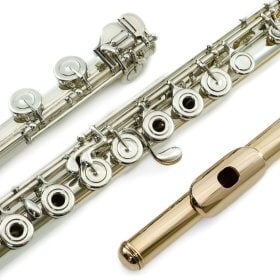
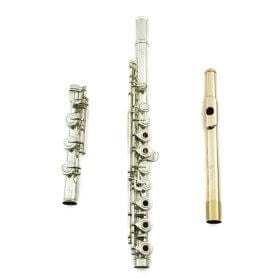
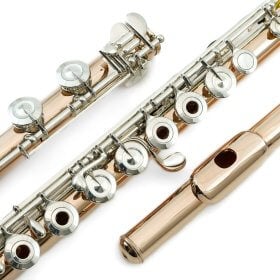
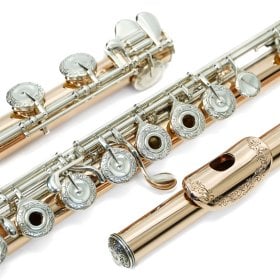
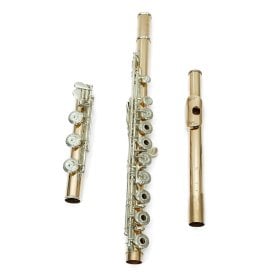
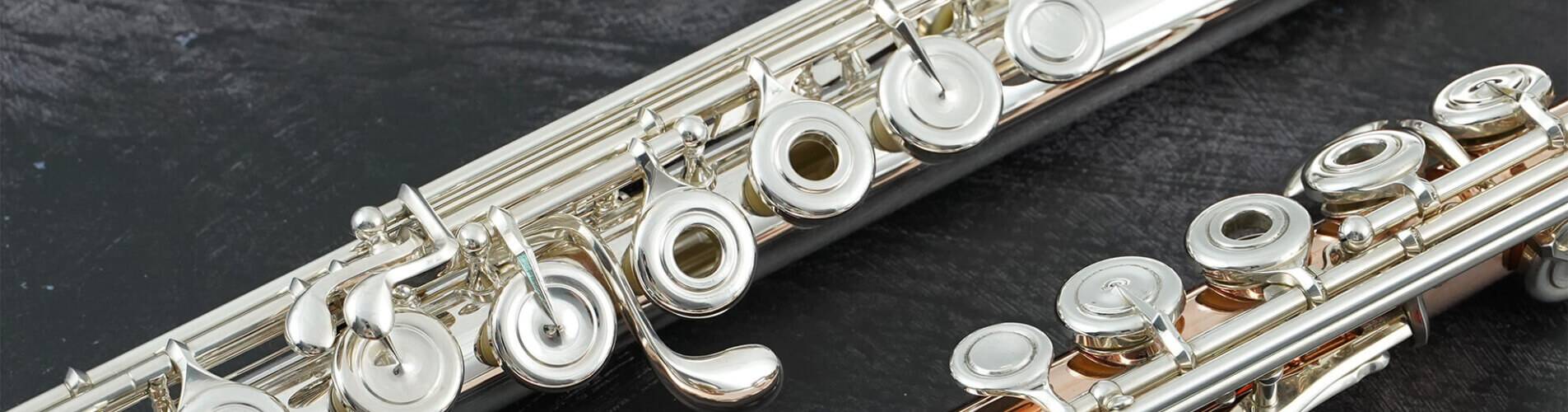
Aurumite consists of a flute tube where 14k rose gold is placed on the inside of the tube and fused to an outer layer of sterling silver. The sound quality of the Aurumite has much of the dark sound of gold but the resonance and projection of sterling silver.

Bass Flute
In the key of C, this large flute sounds one octave lower than the common C flute. It is usually designed to have a curved headjoint due to its long tube. Some manufacturers offer a low B foot joint option. It is often used in small flute ensembles and flute orchestras.
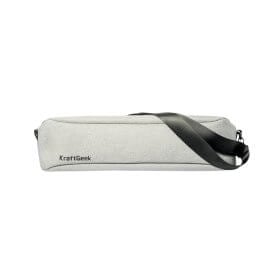

B Foot
This foot joint reaches down to low B, one half-step lower than the C foot, by adding one more key and extending the length of the flute. The B foot joint adds weight to the overall instrument which increases resistance and results in producing an overall darker tone versus the brighter tone of a C foot joint. The B foot joint improves the overall pitch of the third octave. It is the standard flute choice for contemporary compositions requiring extended techniques.


Britannia Silver
Historically silversmiths used this alloy of pewter-like density for domestic utensils. Altus flutes has created its own alloy that contains 95.8% silver. Because the alloy has an increased density, a darker richer sound is achieved without the use of a greater wall thickness.

Bubble headjoint
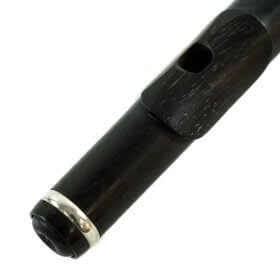
Refering to the shape of a wooden piccolo headjoint that is wider near the tenon of the piccolo to add thik strength to the wood.


C Foot
This foot joint reaches down to low C (middle C on the piano). It is frequently described as freeing up the low register and offering less resistance throughout the flute.


Coin Silver or Solid Silver
It is also refered to as - solid silver. This silver alloy contains 90.0%.

Conical bore
When a wind instrument is made with a tapered tube, it is referred to as a conical instrument. Today it is more common for piccolos to have a body with a conical bore, narrow at the bottom end and wider at the top end. When the body of the piccolo is conical, the headjoint is cylindrical for proper intonation.

C# Trill Key
A C# trill key is a lever that activates a key over an extra C# tone hole. This makes trilling from B to C# easier. There are also other uses of this key which facilitate fingerings for other trills and tremolos. Most notably it gives a reliable third octave G to A trill by fingering high G and trilling the C# trill key and the D trill key together. Additional trills include High F# to G#, High Ab to Bb. Tremolos are also easily executed between first octave G, Ab, D, Bb, B, or C to C#, D or D#. In the second octave, tremolos of A, Bb, B, or C to C# are made easy. It is normally available with offset G only.


Crown
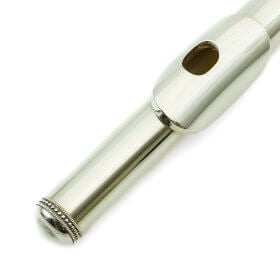
The dome - shaped part at the very end of the head joint. It is attached to the head joint cork and disk assembly and can control their position. These assemblies are highly important in the projection, intonation, and quality of the sound.


Curved Head Joint
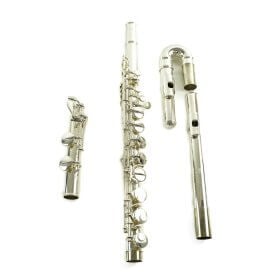
It is a "U" shaped head joint that provides a shorter reach to the keys of the flute.
It can be found on bass and some alto flutes, as well as on student model flutes for younger players (also used in the Suzuki method).


Drawn Tone Holes
The tone holes are pulled (drawn) up from the main tube of the flute and then shaped.

D# Roller
This roller is mounted on the D# key. It facilitates the sliding motion of the little finger between the D# key and the lower keys of the foot joint.


Eb Flute (Soprano)
It is smaller in size than the C flute and sounds a minor third higher. It is a transposing instrument used mainly in flute choir music.

French Model Flute
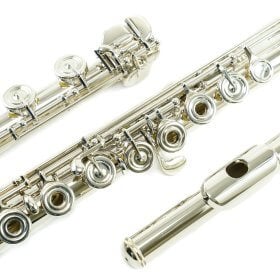
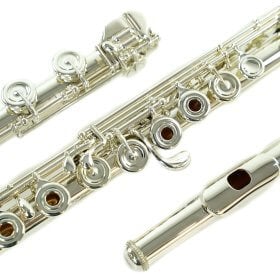
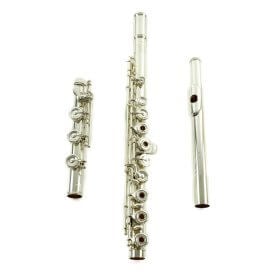
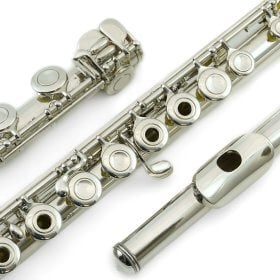
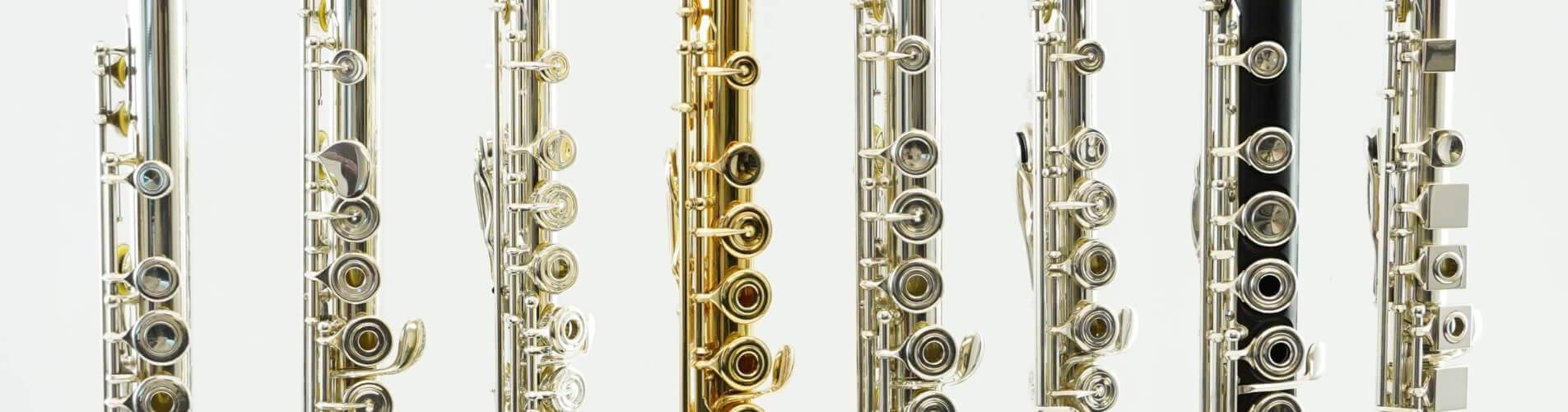
Also known as an open hole flute, it is a flute with venting holes at the center of the A,G,F,E, and D keys. These holes can be closed with specially made plugs that can be inserted or removed by the player. The plugs are normally used during the adjustment period from a closed hole flute to an open hole flute.


G-A Trill
Flutist often use this term interchangeably with the C# trill, but it's quite a different mechanism. The true third octave G-A trill incorporates two additional tone holes, covered by pads mounted on a single rod. This makes trilling G to A easier, but it does not offer the versatility of the C# trill in playing other trills and tremolos. This option is available on some handmade models.


Gizmo Key
A small raised lever mounted on the low B key arm to facillitate the individual closing of the low B key. Also known as "high C facilitator", this lever helps in producing clearer 4th octave C.


Handcut Embouchure
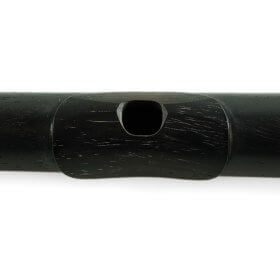
It is an extra refining step of undercutting and smoothing of the edges inside the embouchure hole beyond the standard process. This is done to improve response and richness of tone.

Handmade Flutes
All flutes require a considerable amount of "hand" work. The term "Handmade" refers to the upper level professional instrument assembly which requires extreme precision of workmanship and superb attention to details. This term also distinguishes handmade flutes from mass produced flutes.Handmade flutes are normally made with soldered tone holes.

Heavy / Medium / Thin Wall
Refers to the thicknesses of the tubing used in flute construction. The thickness generally ranges between .012" (thin) and .018" (heavy). The choice of tube thickness is a matter of personal preference of the player.

Head Cork
Cylindrical cork placed inside the headjoint, mounted on a threaded rod which holds the crown. The position of the head cork determines the fine-tuning of the instrument.


High E Facilitator
A less mechnically-complicated way to reduce the venting of the G key, and thus to improve the high E response, is to attach a disk or washer to the inside wall of the G tone hole. It is sometimes named "the donut" for its shape.


Inline-G Key Flute
The G keys are placed in a straight line with the rest of the keys on the flute, mounted on the same rod next to each other.


New Scale
Because of the gradual raising of the pitch (from A= 435 to A = 444) over the last century, it was necessary to recalculate, reposition and redesign the placement of the tone holes of the flute for more correct intonation. Many of the flute makers today incorporate these new scale corrections into their design and offer it as the "New Scale" or "improved scale".

Offset G Key Flute
In this model the G keys are offset slightly from the rest of the keys, mounted on their own posts, separate from the other keys. A growing number of flutists prefer the comfort and hand position on the offset G flute.


One-Piece Core-Bar
This type of mechanism uses one rod that extends from the left hand C post through the central post, forming a continuous shaft for the left hand mechanism and extending as a stainless steel bearing for the shaft of the right hand keys. The traditional construction uses two shafts for the left hand mechanism instead of one.


Piccolo
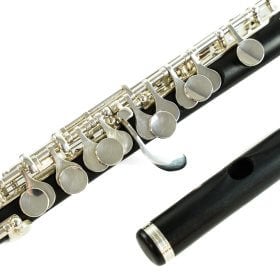
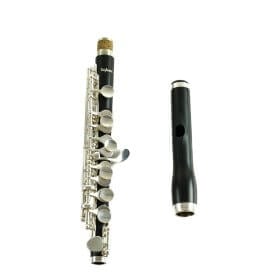
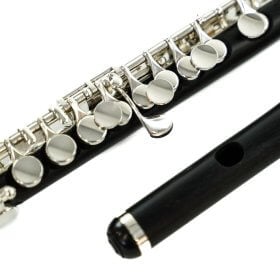
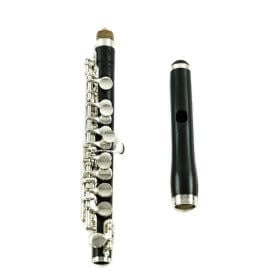
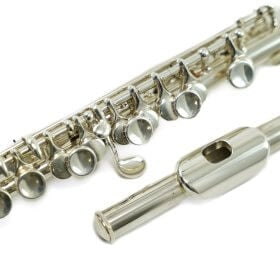
The small "octave flute" ranges from D2 to D5 and is less than half the size of the C flute. Most piccolos are designed to have a cylindrical head with a conical body. The most common student model piccolo is made of silver plated nickel or high impact plastic. The professional models are usually made of silver or hard wood (Grenadilla, most commonly).

Pinless Construction
Traditional flutes use pinning needles inserted into the inner mechanism rods to secure certain keys to a fixed position. Pinless construction, on the other hand, uses bridge mechanisms and socket-head screws for the same purpose. Most flute mechanisms today are constructed with pins.


Plateau Model Flute
A closed hole flute. A flute without venting holes at the center of the keys.


Pointed Key or Style Key
A key design that connects keys to the rod with a raised, pointed arm which extends to the center of the key. Also refered to as "Styled keys" or "French pointed arms". It is not common in student or intermediate models.


Riser
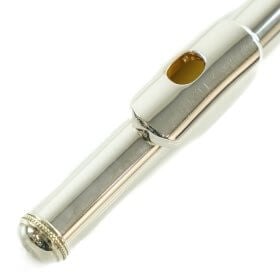
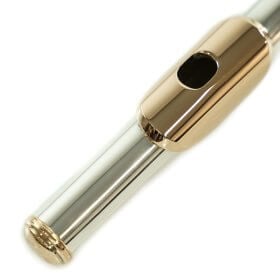
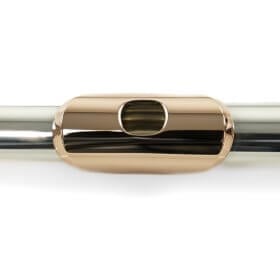
The part ("chimney") that connects the lip plate to the head joint tube. Some flute makers offer a gold or platinum riser on silver flutes as an option.


Soldered Tone Holes
The tone holes of the flute are formed separately and then soldered to the body of the flute.

Split E Mechanism
A split E mechanism allows venting only one G key while fingering high E. This facilitates production of the high E and it provides a more stable response. This is a special order option available on most flutes (see High E Facilitator).


Springs
They are the wires installed horizontally below the key and control the reverse vertical motion of the keys. The most common spring wire used by manufacturers is copper, stainless steel, and for the more expensive instruments, gold or white gold. The type of wire and its thickens effects how the key mechanism feels in the hands of the player. Some players prefer light touch and some prefer more resistance. Springs can be adjusted to different tension to suit the player.

Sterling Silver
A silver alloy that consist of 92.5% silver that is generally stengthened with copper for hardness. It is the most widely accepted silver today by flute makers.

Student Model
A general term that refers to a beginning or entry-level instrument. Usually made of silver or nickel plated tubing, with closed holes keys, offset G key, and C foot. Unlike stringed instruments, this model is the same size as the upper-level flutes. Some manufacturers referr to it as a Standard model flute.

Y key arm
Refers to the shape of the key arm soldered to the back of the key (as opposed to the top of the key as in the pointed key arms.)


Help Desk


Home | Help Desk | Shopping Cart Help |
(c)2005-2010 Present- Flute World Company, Inc. / Web Design by OMAcomp version 2.01